
64 Waukesha Voters Arrive At Wrong Polling Location Tuesday, Citing Downtown Street Sign Panic
An unofficial survey found that more than half of the lost voters simply gave up and turned around.
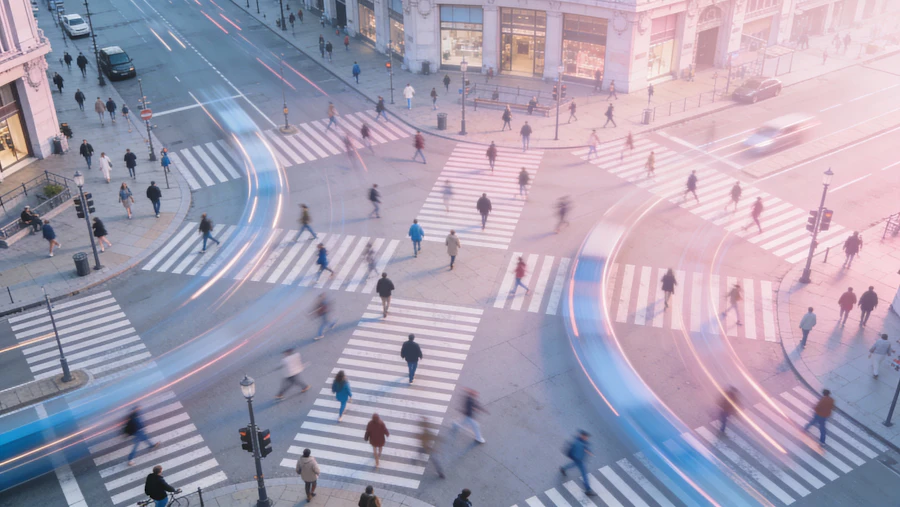
WAUKESHA — With Wisconsin's primary election five days out, city officials confirmed Friday that a weekend test run of the downtown voting route sent 64 local residents to the wrong polling location, with 38 of them abandoning the search entirely rather than locate the correct address.
The unofficial survey, conducted Saturday by city staff who stationed volunteers at three downtown intersections and asked passersby to attempt to find their assigned polling place using only the address printed on their voter registration card, was intended as a dry run ahead of Tuesday's vote. Instead, it produced a 59 percent abandonment rate among participants who set out to find the correct building and never did.
City Clerk Bob Krueger said the results, while sobering on their face, matched his expectations almost exactly. "We've theorized for years that the one-way grid downtown functions as a kind of natural sorting mechanism for voter commitment," Krueger said. "The people who make it through Broadway and St. Paul without giving up are, generally speaking, the people who were always going to vote."
The Grid Problem
Waukesha's downtown one-way streets reverse direction block by block, with Broadway running north-south for a stretch before the pattern flips, and St. Paul Avenue doing the same in the opposite sequence a block over. The arrangement, unchanged since a mid-1990s traffic study, has long been a source of local frustration for delivery drivers and out-of-town visitors. Saturday's test marked the first time the city formally measured its effect on a civic function rather than a delivery schedule.
Of the 64 participants who ended up at the wrong address, city staff logged 21 who arrived at a building one block over from their actual polling place, 17 who circled the same intersection at least twice before giving up, and 4 who reported crossing the Fox River twice in the course of the attempt. The remaining 22 were unaccounted for by the time volunteers packed up at 4 p.m.
"We've theorized for years that the one-way grid downtown functions as a kind of natural sorting mechanism for voter commitment."
— Bob Krueger, Waukesha City Clerk
Krueger's office has placed printed maps at three major intersections as a preventive measure ahead of Tuesday: Broadway and St. Paul, St. Paul and Barstow, and Grand Avenue and North Street. Each map is laminated and mounted on a sandwich board, with an arrow marked "YOU ARE HERE" that Krueger's staff repositions each morning depending on which board was knocked over by wind overnight.
Some Voters Still Confused About The Deadline
Complicating the picture further, Krueger said his office has fielded a steady stream of calls this week from residents under the impression they could still register or request an absentee ballot after early voting closed Aug. 7. "We get some version of this call every cycle, but this year it's specifically people who say they saw the sign for early voting and assumed the deadline moved with it," Krueger said. "The sign did not move. The deadline did not move."
The city has not changed its polling place assignments this cycle, meaning the 64 test-run participants who got lost were, in nearly every case, attempting to find a building they had successfully located in prior elections. Krueger attributed this less to memory than to habit erosion. "You do it every two years, you forget the specific turns in between," he said. "It's not that people are getting worse at this. It's that the grid gives them fewer chances to relearn it correctly before it matters again."
Krueger said his office does not plan to request a change to the one-way pattern itself, calling that a Department of Public Works matter outside his authority, but said he has "informally mentioned it" at two of the last three interdepartmental meetings. Asked whether the 59 percent abandonment rate from Saturday's test would factor into Tuesday's staffing plan, Krueger said the office had already added one additional poll worker at each of the three mapped intersections "to point, mostly," and returned to a stack of laminated sandwich-board arrows that needed sorting before Monday.